Pruning has begun
Reducing the risk of frost damage
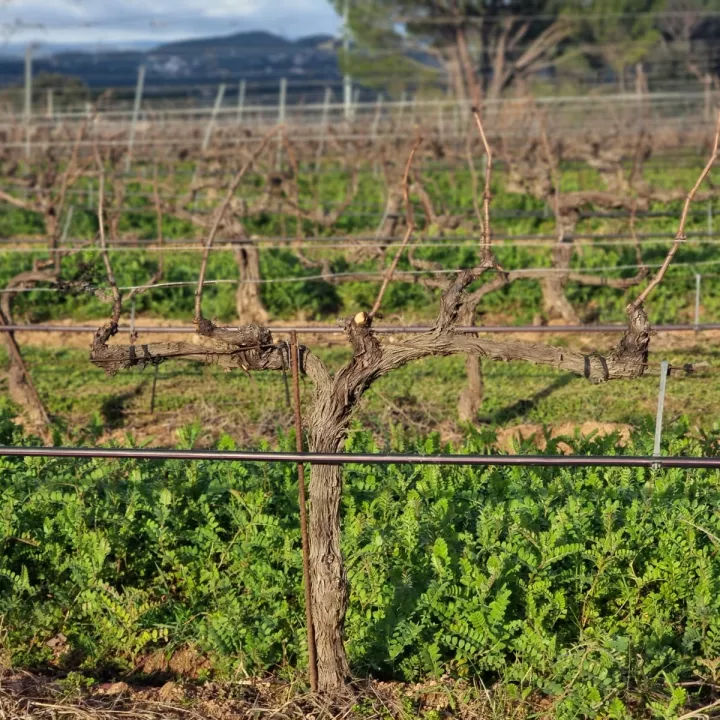
These days, we’re starting to prune our vines. The vine is a climbing plant and thrives in sunlight. After years of ‘training’, during which it is shaped into its horizontal and vertical form, it grows year on year from a base height of around 70–80 cm to up to 2.50 m.
Unlike trees, which take on a specific shape as they age, the vine only acquires its recognisable form through regular pruning during or after its winter dormancy. Furthermore, as a climbing plant, it cannot grow upright without support and therefore requires assistance from stakes and wires. The pruning season therefore consists of two tasks: cutting back the ‘foliage’ that grew last year and repairing the posts and wires.
Due to the climatic changes of recent years, pruning has become much more complex and labour-intensive. In the past, it was common practice – and possible – to prune the vines during the winter months in a single pass, hectare by hectare, over a period of 3–5 months. Nowadays, however, (too) warm springs and the resulting (too) early shoots can lead to significant damage if late frosts in April or even May coincide with early budburst.
To prevent young, green shoots from being destroyed by spring frosts, we now prune twice. In January and February, whilst the vines are dormant, we remove all surplus shoots for the coming year. However, we only cut back the shoots selected for the coming year (approx. 4–5 per vine) to leave 5–6 winter eyes (potential buds). It is only in a second stage, at the end of March/beginning of April, that these shoots are also pruned back to the cane. By carrying out the final pruning late we can delay bud burst and at least reduce the risk of frost damage.